Choosing a training program for your employees can impact your business growth. However, most small businesses undervalue the importance of training employees after they are onboarded. For instance, you might feel that a training program is too expensive or fear your employees will leave upon upskilling.
However, not training your employees will harm your business growth. For instance, consider that a lack of software training within an organization can lead to delayed task delivery and overall poor performance.
Additionally, workplace training programs increase employee retention and satisfaction. According to a study by Devlin Peck, 68% of employees prefer workplace training, and 56% of this number prefer a personalized method of training.
Most companies have a dedicated budget for employee training, unlike small businesses. However, you no longer need to buy an expensive corporate training LMS. Today, we have tools like Cassava to help you create, deliver, and personalize custom training programs for your employees.
The right training program will help your employees increase productivity, competence, and confidence in your business. It is also a great way to stay ahead of industry trends and apply the best practices to grow your business.
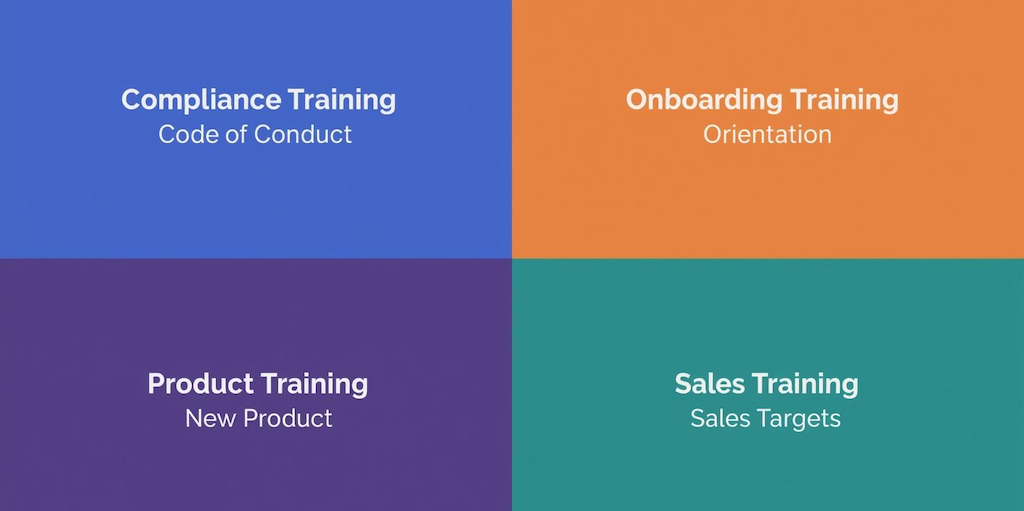
In this article, I will discuss 4 types of training programs to consider for your employees and how they will impact your business. They include:
- Compliance training programs
- Onboarding training programs
- Product training programs
- Sales training programs
But before we get to that, let’s talk about a few factors to consider when choosing a training program.
How to choose a training program for your employees
Training your employees is an investment for your business. However, not every program will align with your objectives or business growth stage. When enrolling your team in a training program, consider various factors, including your business goals, skills gaps, mode of training, and expected outcomes.
Begin by identifying and outlining what you want your employees to be able to do or achieve upon completing the training. While doing so, evaluate the skills they already possess and select a training program that will bridge this gap.
A great training program should have interactive modules and skills that are applicable in the workplace. Additionally, choose a training program that offers a personalized delivery method.
A common challenge when enrolling employees in a training program is addressing different learning styles. However, training program software makes it easy to personalize employee learning experiences.
Now, let’s look into the 4 types of employee training programs to consider.
Compliance training programs
Compliance training programs educate employees on the laws and regulations applicable to the industry. They are often mandatory for employees and require proof of completion from the parties involved.
Workplace compliance training is crucial, particularly in industries like construction. These programs help businesses avoid legal problems and prevent unethical conduct. Compliance training certificates provide credibility, which improves your overall reputation.
Examples of compliance work training programs include:
- Occupational Safety and Health Training (OSHA)
- Anti-harassment training programs
- Diversity training programs
- Cyber Security Training
Onboarding training programs
Onboarding training programs vary across companies. Often, these programs welcome new hires into the company, helping them get familiar with the company policies and job functions.
In most cases, you will have your custom onboarding training program. You can use an onboarding program to help acclimate new team members within the first few days or weeks.
Onboarding training is especially critical for companies with hybrid and remote teams. New employees learn at their own pace and can be integrated into the company more quickly and with reduced effort.
In some cases, onboarding training programs can focus on providing a specific skill for the position. For instance, when training an employee on how to use a particular business tool to achieve desired results, such as CRM software.
An effective onboarding program features a series of activities, including learning the company’s objectives, products and services, workplace culture, and the expected KPIs. This training may also involve shadowing senior employees to gain a deeper understanding of the company.
Product Training Programs
Product training is an important aspect of any business. This training equips employees with in-depth knowledge of the company’s products, their features, and functions.
While it is common for product training to be briefly mentioned during onboarding, certain departments, such as sales, marketing, and customer service, require a much deeper understanding. Your sales team needs to understand the product’s benefits and use cases, as well as how they compare to the competition, when engaging with customers.
Additionally, your customer support team must also understand the product’s functionality to provide the best solutions to your users during demonstrations. And lastly, the marketing team must learn the product features, solutions, and use cases to craft effective messaging and branding.
Therefore, it is essential to select an effective delivery method to ensure that your employees can access and engage with your program efficiently. Workplace training often groups all employees without considering their individual learning preferences, particularly when these preferences are heavily influenced by departmental communication styles. Sales professionals may favor direct contact via phone and email, whereas marketers often live their days plugged into social platforms.
With Cassava, we have developed a platform that acknowledges these distinct learning styles, which are key drivers to overall engagement, adoption, and retention of your training programs. Cassava enables you to integrate your training programs seamlessly with popular workplace communication platforms, including Microsoft Teams, Webex, Slack, and good old-fashioned email.
This means that you can now deliver and optimize your product training program to best align with the preferences of your employees and departments.
Sales Training Programs
Your sales team serves as the bridge between you and your customers. They must understand your product or service offering better than anyone else. After all, your sales team will help your customers realize the benefits of your product or services, and what makes your company stand out from the competition.
A sales training program will focus on teaching your team the best practices to communicate with prospects and customers. It enables you to create a seamless sales cycle that effectively addresses consumer needs.
Summary
Implementing training programs for your employees is a critical process that must align with your business objectives. Therefore, when choosing a training program, you must thoroughly analyze what you need them to do after getting the training. Next, analyze the skills they already possess and understand the skills gap you need to seal. Only then can you select an effective and impactful training program for your employees.
You no doubt have an opinion bubbling to the surface.